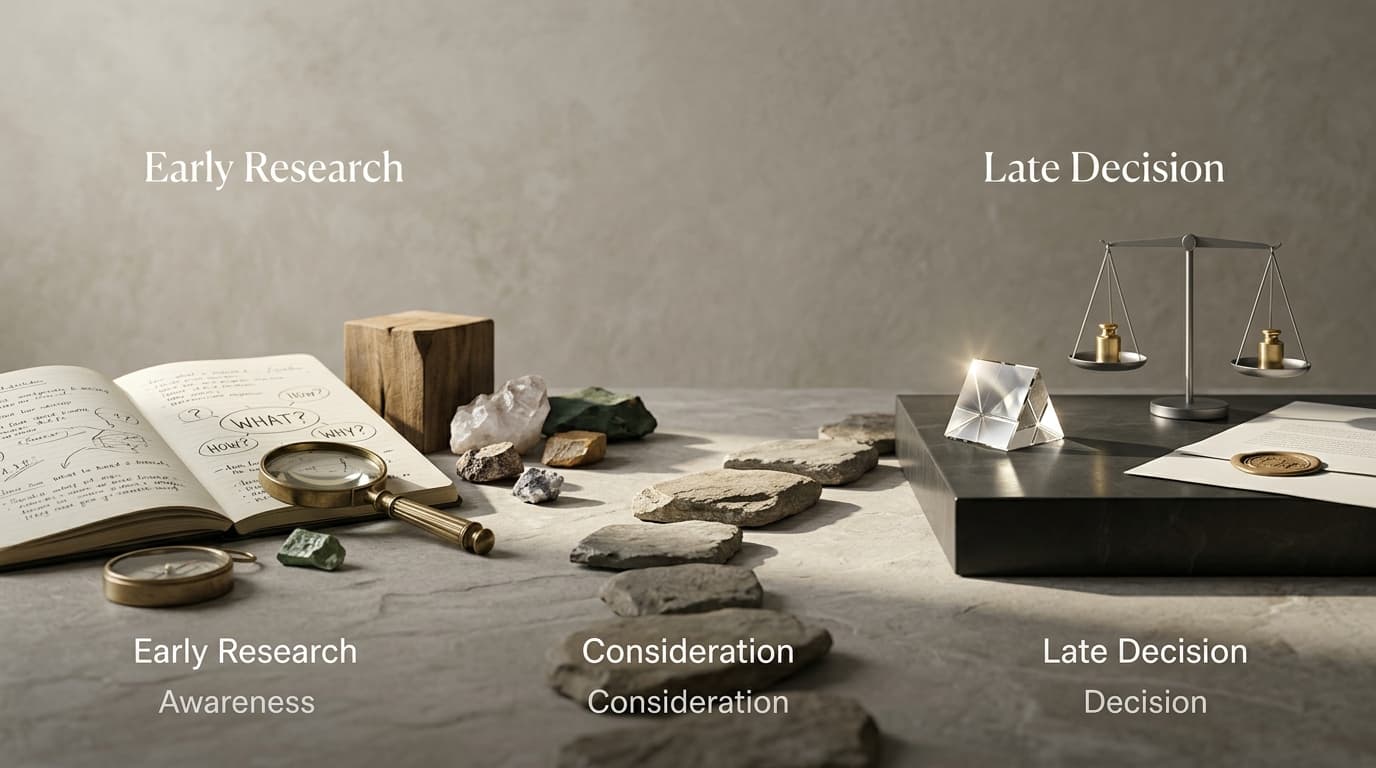
Early research questions and late decision questions sit at opposite ends of the buyer's journey, and the difference decides what content you build and when you publish it. An early research question is one a prospect asks while defining a problem, using words like "how," "what," or "why." A late decision question is one a prospect asks when they are choosing between specific solutions and ready to act, using words like "best," "vs," or "buy." The buyer's journey runs through three stages, Awareness, Consideration, and Decision, and the depth of the questions grows with each one. Early questions want education. Late questions want proof. Getting this mapping right matters because the two question types carry different commercial value and demand different formats. Serve a decision-stage sales page to someone still naming their problem and you get ignored. At 10xSearch in Centennial, CO, we treat this mapping as the foundation of an editorial plan, not an afterthought.
How Do You Tell Which Stage A Question Belongs To?
You tell a question's stage by reading three signals in order: the words in the query, the search results those words return, and your own audience data. No single signal is definitive, so the reliable method stacks them.
Keyword modifiers give the fastest first read. Informational queries often include "how," "what," "why," or "guide." Navigational queries include a brand or product name. Transactional queries use words like "buy," "price," "cheap," "discount," or "near me." Commercial queries use "best," "top," "review," "vs," or "alternative." Google treats commercial intent as pre-transactional: the user intends to buy but needs a little extra convincing, which is why comparison searches sit at the late end.
Modifiers alone can mislead, so inspect the results page next. Typing your target keyword into Google and studying what ranks is one of the most reliable techniques available. Featured snippets, Knowledge Panels, and "People Also Ask" boxes point to informational intent. Shopping carousels and product pages point to transactional intent. Comparison articles and review roundups signal commercial investigation.
The four core search intents, commercial, transactional, informational, and navigational, form the classification layer that lets you sort questions in bulk before you decide what to write.
Why Do Early And Late Questions Carry Different Commercial Value?
Early and late questions carry different commercial value because reach and revenue are not the same thing. High-volume informational keywords drive awareness but rarely drive direct conversions. Moderate-volume transactional keywords may be worth more to a business's bottom line than very-high-volume informational terms. A question that pulls thousands of visitors can be worth less per visit than one that pulls a few dozen buyers who are ready to act.
This tradeoff explains why chasing raw search volume is a common and expensive mistake. When you evaluate a keyword's volume, intent classification is critical context. Two keywords with identical volume can have wildly different value depending on where the searcher sits in the journey.
It also explains why early questions dominate the modern journey even though they convert poorly on their own. Independent research now shapes the majority of the buying process. Gartner reported in June 2025 that 61% of B2B buyers prefer an overall rep-free buying experience, based on a survey of 632 buyers fielded in August and September 2024. Buyers spend only a small fraction of their journey in supplier meetings and most of it researching on their own. CEB and Google's partnered research indicates the average B2B buyer is 57% through the purchase decision before engaging a sales rep.
The practical consequence: if you skip early questions, you never enter the consideration set. If you skip late questions, you educate prospects who then convert somewhere else. You need both, weighted by value.
| Dimension | Early Research Questions | Late Decision Questions |
|---|---|---|
| Journey stage | Awareness / early Consideration | Decision |
| Dominant intent | Informational | Commercial / transactional |
| Typical modifiers | how, what, why, "guide" | best, top, vs, review, buy, price |
| Content posture | At least 90% educational | Persuasive and proof-led |
| Commercial value | Reach-oriented, low direct conversion | Higher direct conversion value |
Which Content Format Answers Each Type Of Question?
The format follows the intent: educational assets answer early questions, and proof-led assets answer late ones. Publishing the right format at the right stage is the editorial decision. Tool signals inform that decision, but they do not make it.
For early research questions, build content that is at least 90% educational and just 10% promotional. That means blog posts breaking down a common challenge, practical guides, self-assessment checklists, or a short video validating what a prospect is experiencing. Queries like "how to improve team productivity" or "why projects keep going off track" are answered here. The goal is to help the reader name their problem, not to sell.
For late decision questions, the posture flips to persuasive and direct. Decision-stage buyers have high intent and are actively comparing solutions, so the assets that work are demos, testimonials, pricing pages, case studies, trials, and webinars. This content is built to meet the objections that surface at the decision stage, whether they concern pricing, implementation, or risk.
The middle of the journey deserves its own resourcing note. Buyers at the consideration stage consume 47% more content than at any other point in the journey. That consumption spike is why comparison guides, solution roundups, and vendor-evaluation resources often earn heavier investment than a single awareness post. If you want a repeatable way to organize these assets around real questions, our approach to building content clusters for AI search maps formats to stages across an entire topic.
How Do You Confirm A Question's Stage Before You Build Content?
You confirm a question's stage by combining three data sources, because any one of them can point the wrong way. SERP analysis reveals what Google rewards for the query, tool-based classification provides bulk intent labels, and first-party data from Google Search Console shows what your specific audience searches when they find your pages. The best read comes from stacking all three.
Start with the caveat that keyword tools are useful indicators, not absolute truth. Search volume is often averaged, delayed, and grouped, so real demand can differ from the number on screen. Volume data typically carries a margin of error between 10% and 25% depending on the source's methodology. Treat the number as a range, not a fact.
Tool intent labels are also fallible. The keyword "SEO" has been classified differently by Semrush, SE Ranking, and Ahrefs at the same time, which shows that ambiguous keywords require deeper investigation. Tool labels are built on aggregate data and tell you what Google thinks most searchers want, not what your specific audience needs.
That is why first-party data settles disputes. Your Google Search Console records show which queries actually bring your audience to your pages and what they do next, which is accuracy no third-party tool can supply. When the tool label and your own data disagree, trust your data.
There is one distinction worth keeping clean throughout this process. Telemetry is the measured signal you use to infer where a question sits: search volume, intent labels, bounce rates, and behavioral scoring. Editorial work is the human decision about what to create for that question. These are separate activities. Confusing them produces the most common failure, content scaling without intent analysis, which produces content nobody clicks. For a related framing on how a single question can wear many keyword disguises, see our guide on canonical questions versus keyword variants.
Frequently Asked Questions
What is an early research question?
An early research question is a query a prospect asks while they are still defining a problem, at the awareness stage of the buyer's journey. When buyers are in the awareness stage, they are just starting to realize and research the symptoms of a particular problem. These questions carry informational intent and use modifiers like "how," "what," "why," or "guide."
What is a late decision question?
A late decision question is a query a prospect asks at the bottom of the funnel, when they are choosing between specific solutions and are ready to act. In the decision stage, a buyer is ready to evaluate specific products or services and compare them to others. These questions carry commercial or transactional intent and dominate the final stretch before purchase.
What query modifiers separate early questions from late questions?
Modifiers offer a fast first signal, though not a verdict. Early informational questions tend to use "who," "what," "why," "how," or "guide." Late questions use commercial modifiers like "best," "top," "vs," "review," and "alternative," or transactional ones like "buy," "price," "cheap," "discount," and "near me." Always confirm the modifier read against the actual search results.
Do keyword tools reliably classify search intent?
Keyword tools are useful indicators, not absolute truth. Their volume data carries a 10% to 25% margin of error, and their intent labels disagree with each other on ambiguous terms, as when Semrush, SE Ranking, and Ahrefs classified "SEO" differently at the same time. Verify every tool label against SERP analysis and your own first-party data.
How do I confirm which stage a question belongs to before writing content?
Combine three signals in order. First, read the query modifiers for a quick guess. Second, inspect the search results to see what format Google rewards for that query. Third, check your Google Search Console data to see what your specific audience searches when they reach your pages. When signals conflict, your first-party data wins.